
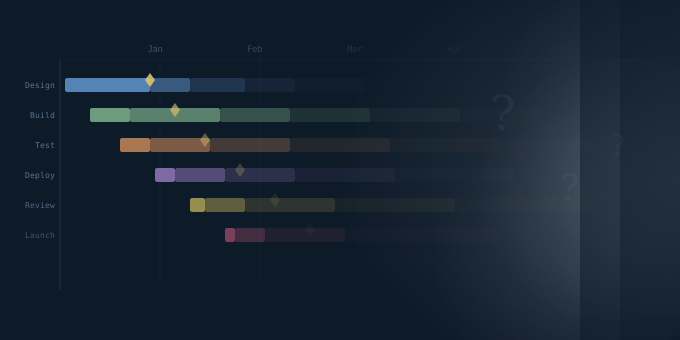
Estimating is inherently imprecise. If you present a project estimate that says the project is done in 6 months, you are implying false precision. Are you stating you are 100% confident in that figure? Creating a perfect estimate requires perfect information about future events that may impact your project. In reality, unless you have a crystal ball, you are giving your best guess. Learning how to express the confidence level of your estimates and improving your abilities to estimate will lead to better, and more accurate, estimates.
Expressing Uncertainty with Monte Carlo
Monte Carlo simulation allows a user to estimate values with ranges, often in the form of a distribution such as a Triangular or PERT distribution. You provide a minimum value, a most likely (called Mode), and maximum value. Maybe based on previous experience we estimate for our project the following durations:
Min | Mode | Max | Distribution |
|---|---|---|---|
5.5 | 6 | 8 | PERT |
Based on these values, a Monte Carlo simulation, using a random number generator, will try thousands of trials across this range using the given distribution. In a histogram where each bar represents the number of times the value was in a certain range, we see the shape of the distribution:
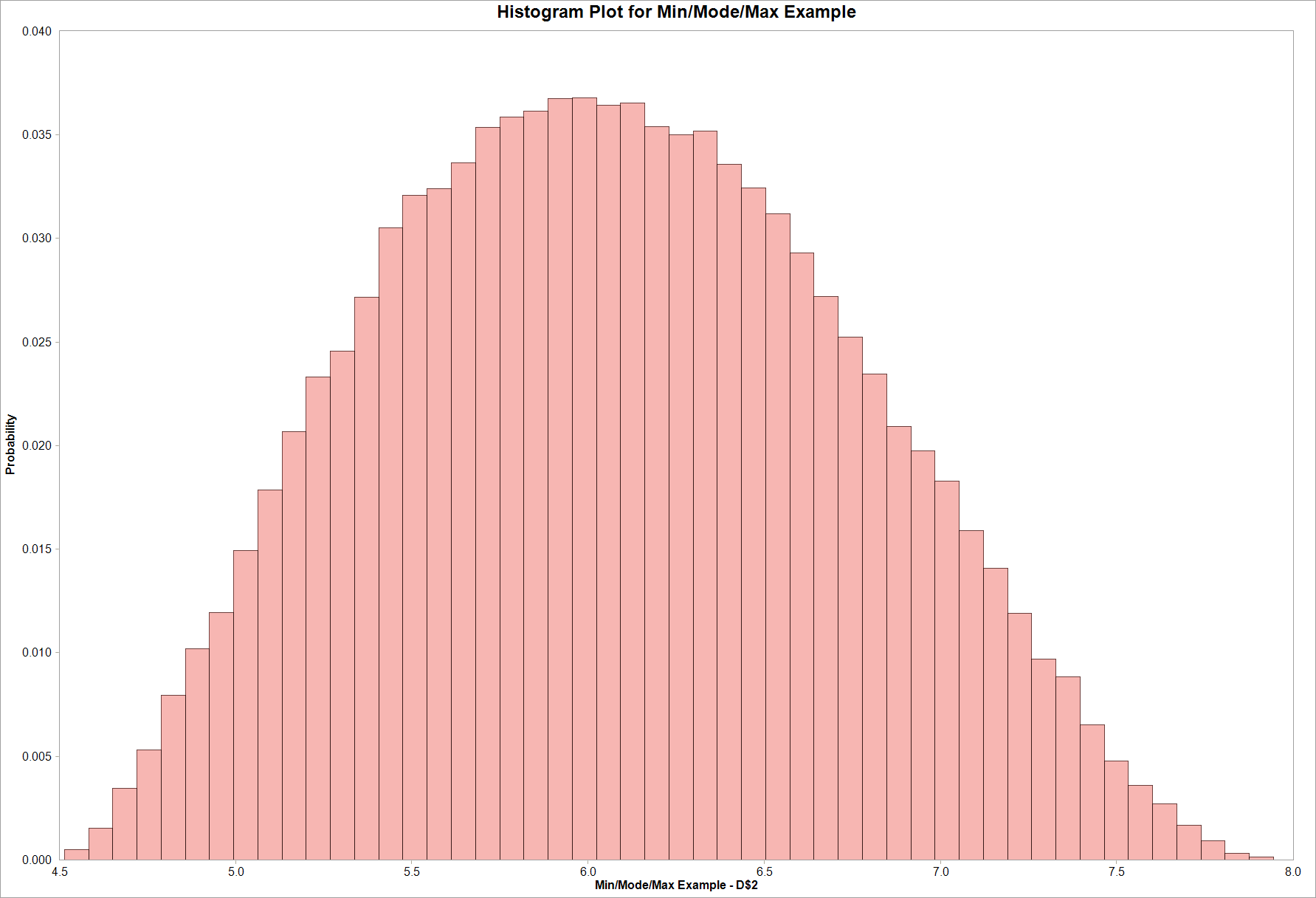
As expected, more often than not, the actual value was near 6 months. What have we expressed here? We are 100% certain that the project will take between 4.5 and 8 months, with the most likely value being 6 months. We've estimated a duration and given our confidence level in our estimate.
Following examples from Douglas Hubbard, et al. [Hubbard, D. W., Budzier, A., & Leed, A. B. (2025). How to measure anything in project management. Wiley.], we may find it more useful to use a 90% confidence level. This allows us to estimate a realistic range without having the range be overly broad to account for all highly unlikely scenarios. In this estimate, we're saying there is a 5% chance the duration could be less than 5.5 months and a 95% chance it will be 8 months or less. Or it can be stated that there is a 90% chance the project will take between 5.5 and 8 months.
5% | Mode | 95% | Distribution |
|---|---|---|---|
5.5 | 6 | 8 | PERT |
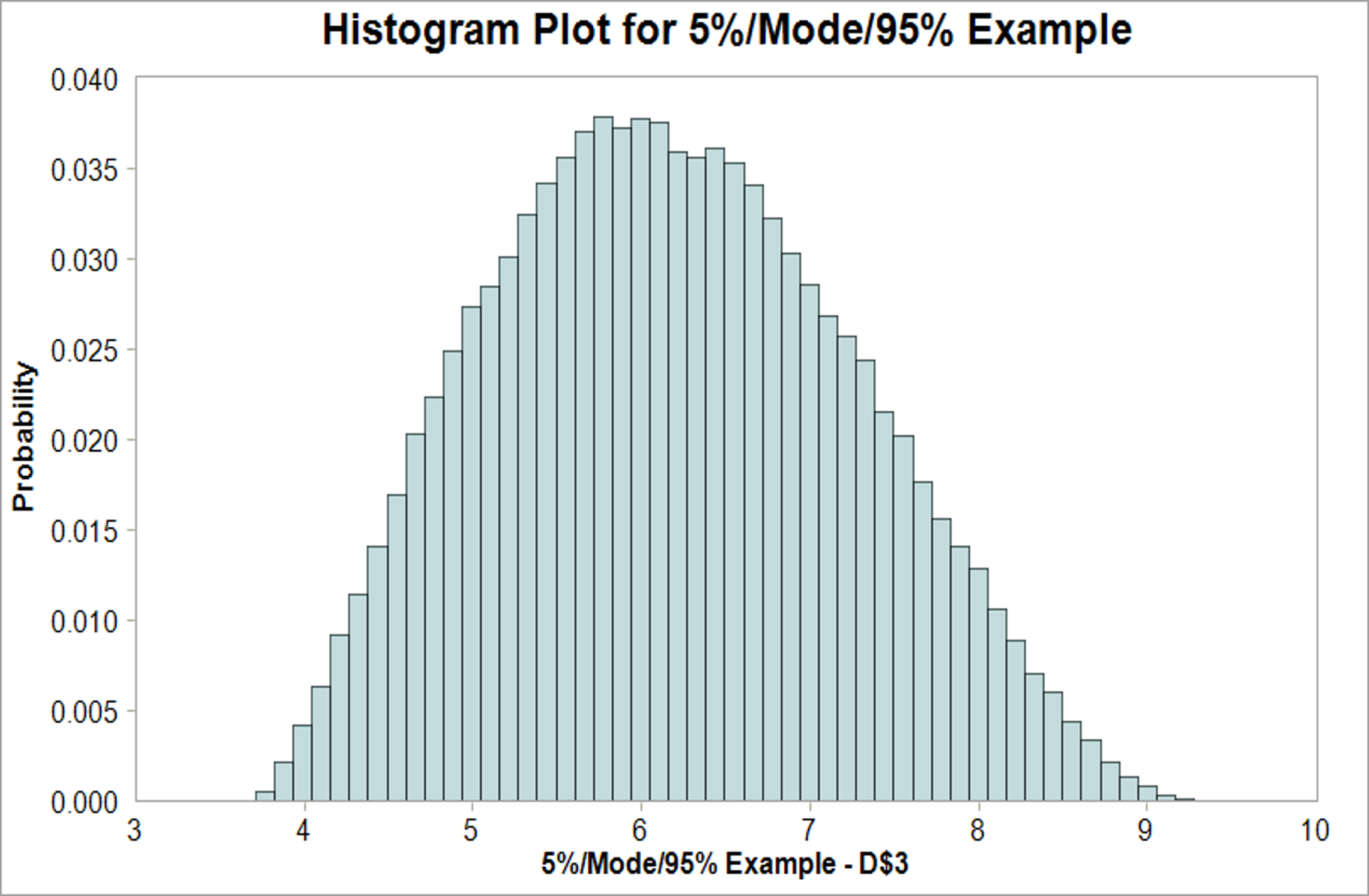
As you can see, there is a long "tail" of outcomes above 8 months. This helps account for highly unlikely scenarios that may still happen 5% of the time.
Accepting Risk
Armed just with this simple estimate, an organization can choose how much risk it is willing to take. In this example, the median duration is 6.14 months. Let's call it 6 months. This means half of the time the project completes earlier than 6 months and half of the duration is longer than 6 months. Basically, it's a coin toss on whether it is more or less than 6 months. Consulting the executives who must balance risk and business objectives, they want an estimate where there is an 80% chance of meeting or beating it. This chart shows a Cumulative Distribution Function (CDF) line (red s-curve) which gives the percent chance of being at or below a value and the 5%, 80%, and 95% probabilities are noted here:
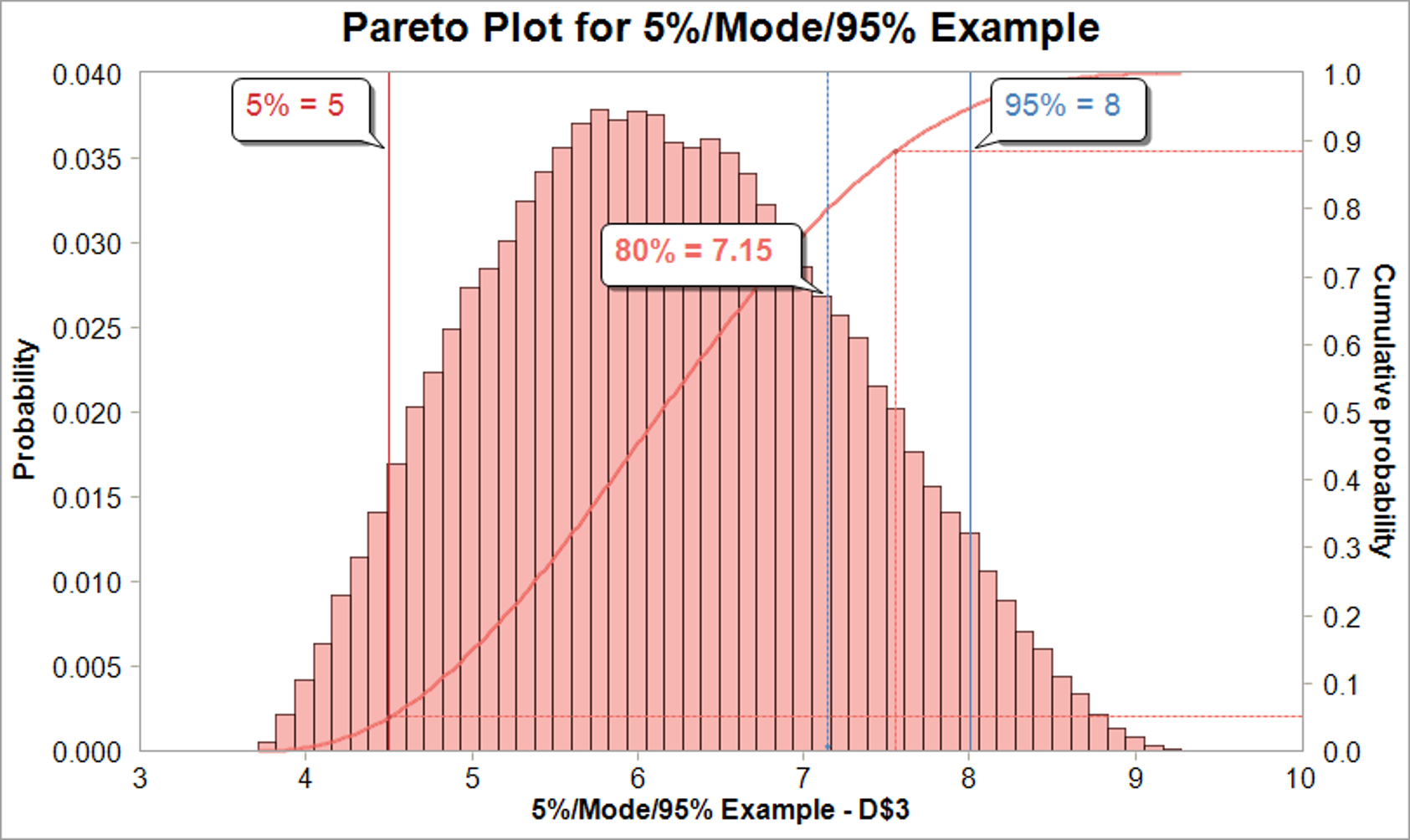
In this case, deciding to allocate 7.15 months for the project will give an 80% chance of success.
Are You Well-Calibrated? Try the Test
Any model or estimate is only as good as the input data. Our duration estimate has a large range from 4 to 9 months. If we were better estimators maybe we could narrow down the range. Luckily, estimating is a skill and you can improve your ability to provide accurate and tighter estimates. The process of learning better estimating skills is called calibration. Lichtenstein & Fischhoff [Lichtenstein, S., & Fischhoff, B. (1980). Training for calibration. Organizational Behavior and Human Performance, 26(2), 149–171. https://doi.org/10.1016/0030-5073(80)90052-5] showed that with proper training, people were able to measurably improve their probability estimation skills. To test our own estimation skills, we built a simple calibration test. You can try out our estimating skills test and see if you are an over-estimator, under-confident, or your estimation skills are dead on.
Let MSEI Help You Model Your Uncertainty
All projects have risk. Being able to quantify and manage it gives you a competitive advantage. MSEI engineers have many years of experience estimating schedules, budgets, and other risks using Monte Carlo. Do you have a project where the stakes are too high for guesswork? Let's model it together. Reach out to MSEI to get started.
 Mease Systems Engineering Inc. delivers software, systems, and data-driven solutions and services for aerospace and themed entertainment. Learn more
© 2026 Mease Systems Engineering Inc. All rights reserved.